Roughly half the Population carry Credit Card Balance from month to month, paying High Interest Rates. The average balance is high enough that the Interest alone consumes an entire month of the average household's grocery budget every year. Credit Card companies are the most profitable segment of banking for one reason. An Enormous Number of people use their Credit Cards in a way that makes Money for the Banks and keeps the Individual Broke. This guide is about being on the other side of that equation.
The two rules that separate Winners from Losers ..
- Never Carry a Balance. Pay the full statement balance every month, without exception. If you cannot, you are borrowing at 20–29% APR and you have already lost. There is no investment, rewards program, or "float" that beats those numbers. Nothing.
- Never spend money on a Credit Card that you would not spend as Cash. Rewards are worth 1–2% back. Neuroscience studies consistently show that people spend 12–18% more when swiping plastic instead of handing over physical bills. The math is not in your favour, even at the best rewards rate, if the card is invisibly nudging you to spend more overall.
Types of Credit Cards
Worth knowing
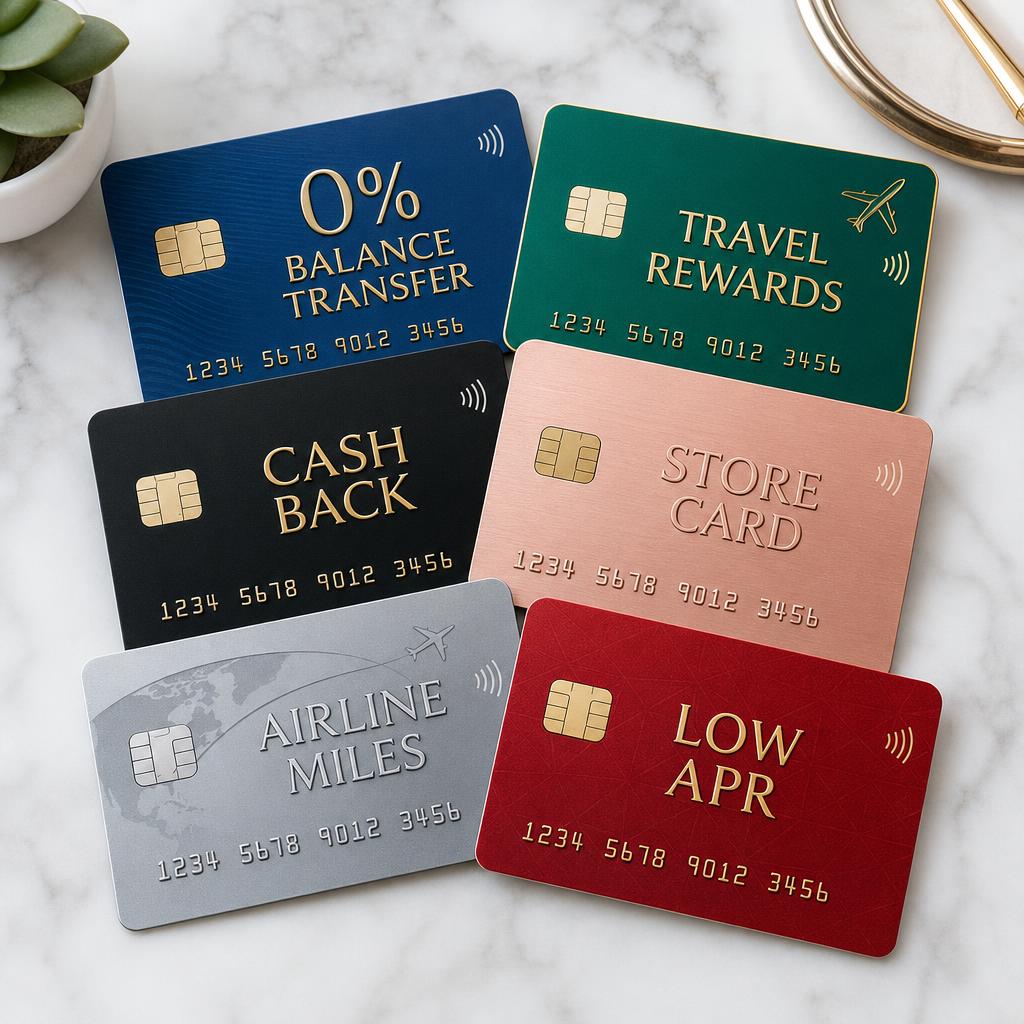
0% Balance-Transfer Cards
The single most powerful Debt-Escape tool available to a consumer. A 0% introductory offer for 18–24 months on transferred balances lets you pay down principal without a single dollar going to interest. The transfer fee (usually 3–5% of the balance) is almost always worth it compared to 22% APR compounding for two years. Move the balance, cut up the old card and attack the principal with every spare dollar during the promotional window.
Cash-Back Credit Cards
The simplest reward. 1.5–2% back on everything, no rotating categories, no Expiring Points, no games. For most households this beats Travel- Reward Credit Cards unless you fly frequently enough to justify the overhead of point valuations. Simplicity has a value that finance gurus routinely underrate.
Travel Reward Credit Cards
Powerful if you Redeem Points for Premium-cabin International Flights, where the Point Value can Hit 10 Cents. Weak if you redeem for gift cards or Statement Credits at 1 cent per point — you would have been better off with a Plain Cash-Back Card. Only worth the annual fee if you personally value the perks (lounge access, credits, travel insurance) at meaningfully more than the fee itself.
Store Credit Cards
Almost always a Bad Deal. 25%+ APRs, thin rewards restricted to one retailer, a Small Credit Limit that hurts your finances ratio, and a Hard Credit Enquiry every time an underpaid cashier talks you into applying. Skip them, the 10% First-Purchase Discount is not worth opening a whole new Line of Credit.
How your Credit Score actually works
Your CREDIT SCORE is not a mysterious number handed down from above. It is a formula, and the weights are public. Understand them and you can move your score by 50–100 points inside a year.
- Payment history (35%) — Never miss a Payment, Ever! Automatically pay the minimum at absolute minimum, then pay the rest manually. One 30-day late payment can drop your score by 60–100 points and stay on your report for seven years.
- Utilisation (30%) — Keep balances below 30% of your total limit at statement close; below 10% is materially better. This is why keeping paid-off cards open helps you: it raises your total available credit and lowers your utilisation ratio.
- Length of history (15%) — Never close your Oldest Card, even if you never use it. Age of credit matters.
- New Credit (10%) — Space out applications by at least six months. Every hard inquiry Costs points and lingers for years.
- Credit Mix (10%) — A Card plus an Installment loan beats a card alone. Not worth taking on debt for, but useful context.

Escaping Credit-Card Debt
If you are already trapped, the plan is not complicated. Stop adding to the Balance Today — freeze the cards, delete Card numbers from every Online account, remove Apple Pay and Google Pay. Every purchase must come from Cash Money you actually have.
Transfer as much as possible to a 0% Balance-Transfer Card and attack the highest-APR balance first with every spare dollar or the Smallest Balance first if you need psychological wins. Read our full Debt Pay-off Guide for the exact step-by-step. This is a solvable problem. The math is on your side when stop feeding the balance.
Signs Credit Card is Destroying you
- You've paid the Minimum for 3 Months in a row without the Balance Decreasing.
- You use one Credit Card to Pay another Credit Card.
- You don't know your exact balance within $200.
- You feel a spike of anxiety when end of Month comes.
- You've applied for a new card in the last six months.
If any of these apply, treat it as a fire, not an inconvenience. This does not resolve itself. The interest compounds daily.
The Credit Card Company is not your friend. It is a business whose entire profit model depends on your inability to pay in full. Read the terms, pay in full, and make the card your tool instead of theirs.