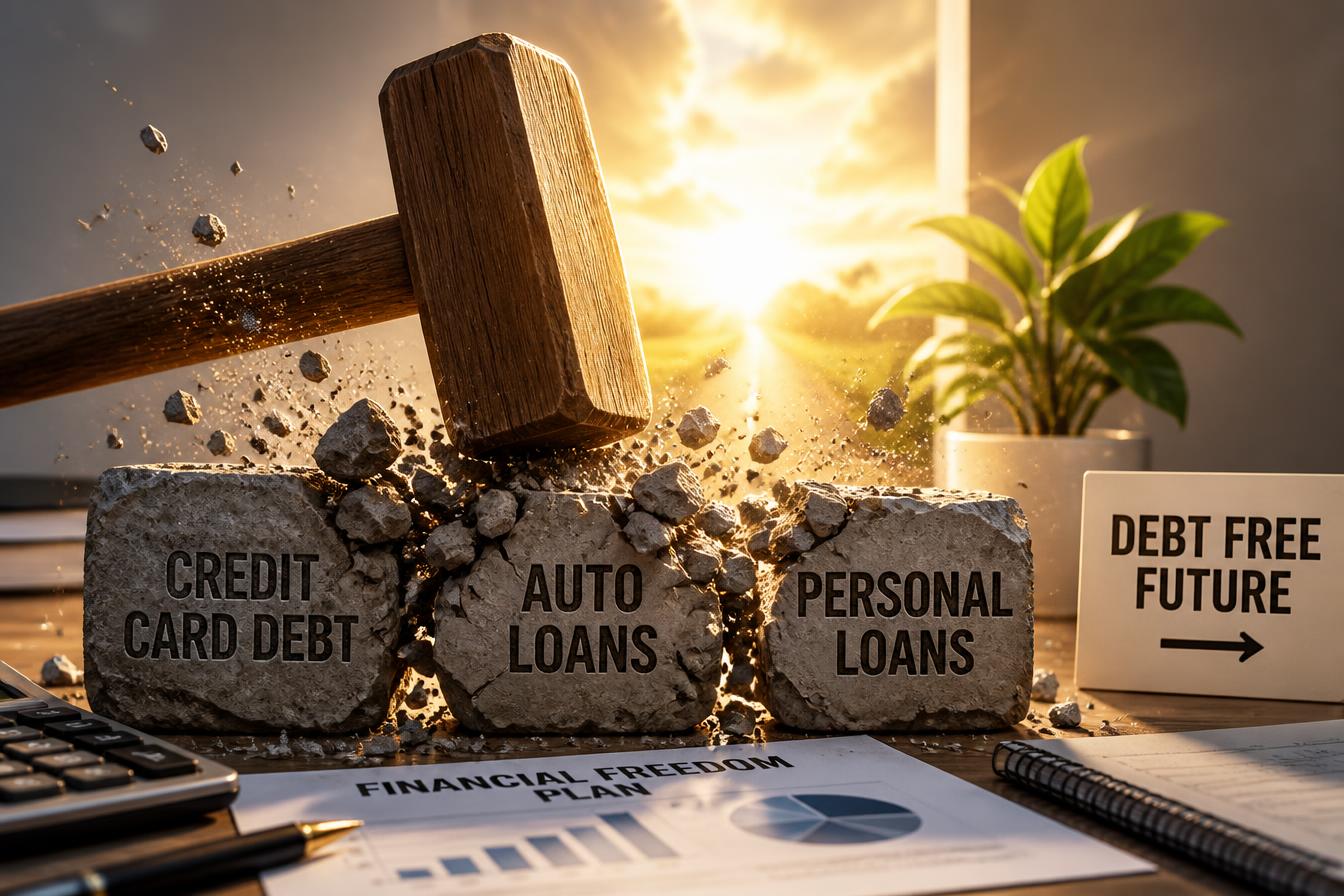
Dedicated Debt-Freedom Plans, Tools & Guides at our Sister Site → www.get-out-of-debt.com
If you are Drowning in Debt then you need to Read This Attentively! The most Important thing to Fix Your Financial Future is to Eliminate All Debts! You cannot Succeed Financially properly until you stop wasting your Income to Interest! The Banks are getting Rich from your Work and Earnings. Millions of people have escaped Consumer Debt every year. There is a proven sequence. It works whether you earn $30,000 or $200,000. Follow it in order, DO NOT Skip Steps, this is the Most Important Element of the Program.
Step 1 — List EVERY Debt
Get a piece of Paper and a Pen and start writing down all the Debts, Subscriptions, Credit cards, Car Loans and Personal loans you have. Next write down the Still Owing Balance of all these Debts. Next research the Interest Rate you are paying on each Debt. Now attack the Highest Interest Rate Debt first with everything you have! Use all your earnings and Income power to smash down those debts starting with the most Expsensive Costly Debt First!
If you don't want to do this then put Simply "You cannot fix what you refuse to look at" and the act of writing it all in one place is super Important to genuinely tackling this Debt Problem head on
Write Down the Total the Balances. Total the Monthly Minimums. Total the Interest you are paying each month The last number is what you are working for right now instead of yourself. It's your motivation to kick this Debt forever and Improve your Finances
Step 2 — Stop the Bleeding
NO NEW DEBT from Today. This is the single hardest step and the one that determines whether the rest of the plan works. Freeze the Credit Cards physically, Cut them up or Freeze them in the freezer, Delete stored card numbers from every online account, Remove them from Apple Pay and Google Pay Auto-Fill and every ability you can to Eliminate the Use of Credit Cards Entirely !
Every purchase from now on must come from money you actually have in Cash or your Bank Account. This feels strange and restrictive for the first two weeks. By week four it feels normal. By week eight you will have quietly reset your past relationship with impulse spending, and moved to new Cash Only Permanently.
Step 3 — Build a $1,000 Emergency Fund
Before you Attack Debt Aggressively, work to Save $1,000 to your Bank Account or have it in Cash in a Safe Place. Its only job is to provide Life Support to life's unexpected financial problems, such as car repair, a broken phone, or medical problem. Without this buffer, the next unexpected $400 expense undoes all your hard work and progress to Paying off your Debts and Credit Cards.
Sell things you No Longer Need. Work Extra hours, Cancel every Non-Essential Subscription, Do whatever it takes to hit $1,000 within 30 days. This is your FIRST WIN and psychologically it matters more than anything else, it shows you can Succeed !
Step 4 — Choose Your Debt Elimination Method
Avalanche Method (mathematically optimal)
Pay the minimum on every debt, then throw every spare dollar at the highest-APR debt regardless of balance. When it's fully paid, roll that payment plus its minimum into the next-highest-APR debt. Repeat. This saves the most interest overall — often thousands of dollars across a full debt payoff. It is the correct choice if you can hold motivation across long stretches without visible wins.
Snowball Method (psychologically optimal)
Pay the minimum on every debt, then attack the smallest balance first regardless of interest rate. You will close accounts faster, feel wins sooner, and stay motivated through the long grind. It costs slightly more total interest, but studies consistently show that significantly more people actually finish. If you've tried before and given up, use snowball. A completed plan at 22% is infinitely better than an abandoned plan that was mathematically optimal.
Step 5 — RE-FINANCE and CONSOLIDATE
A 0% Balance-Transfer Credit Card with 18–24 month promotional window can Eliminate Interest Entirely on transferred Credit-Card Balances — the transfer fee (typically 3–5%) is almost always worth it compared to 22%+ APR compounding. A Personal Consolidation loan at 7–10% APR beats card APRs of 22%+. Home Equity loans work but stake your house — proceed with caution. See our credit cards guide for how to pick the right balance-transfer card and use it correctly (spoiler: do not put new spending on it).

Step 6 — ACCELERATE with Extra Income !!
Cutting Expenses is Great, but it has a floor. Earning more has No Limits and Ultimately Decides how Prosperous you can be in Life. Every dollar of a Side Hustle, Online Business, Overtime Work-Shift, or Freelance Role should go Directly to smashing down Debts — no Lifestyle Upgrades until all Debts are GONE. Even $200 a week of extra income destroys debt at a rate that shocks people when they finally do the math. Read our full guide to increasing income for twelve concrete starting points, from tonight through this year.
Step 7 — Build Massive Fund
Once consumer debt is gone, keep the exact same monthly payment going — but now redirect it into a High-Yield Savings account until you have 3–6 months of essential expenses saved. This is what permanently stops the debt cycle from restarting. Without a proper emergency fund, the next crisis puts you right back where you started. With one, you are genuinely, structurally safer than about 60% of households in the developed world.
Common mistakes to avoid
- Paying off Debt while having no emergency fund The next surprise puts you straight back on the cards.
- Closing old Credit Cards after paying them off. It shortens your credit history and spikes your utilization ratio. Cut the plastic in half but leave the account open with small amount
- Ignoring the Interest Rate. A $500 debt at 25% APR is more urgent than a $5,000 debt at 4%. Follow the math, not the size.
- Debt Consolidation without Behaviour change. Consolidating and then continuing to spend just doubles the debt. Fix the leak before you re-plumb the house.
- Paying more than the Minimum on the wrong debt. If you're using the High Interest First method, the extra $100 on the low loan is not attacking the high-APR loan completely.
- Trying to Invest and Pay Off High-Interest Debt Simultaneously. You cannot earn 22% guaranteed anywhere. Kill the high-APR debt first, then invest.
What life looks like with Success
The day the last Consumer Debt is Paid off is the day your income becomes yours again. Everything you earn from that moment either builds wealth or buys freedom — nothing gets in the way of building your Financial Freedom and Future Successt. That average monthly minimum payment across all your debts, redirected into investments at market returns, becomes life-changing wealth in a shockingly short time. This is not a fantasy. Millions of people cross this line every year. You can be one of them, starting this week.
Debt is a Financial Burden. Remove the Shackles and Free your Finances to Start Investing ! The second: Climb out of Debt with Physical Effort one handhold at a time. There is no other way, it will take some work, but Worth It !